I’m going to try something a little different.
For the next 30 days, I’m going to use ChatGPT as a golf practice assistant.
Not as a replacement for a golf coach. Not as some magic AI swing guru. And definitely not as a reason to abandon common sense.
But as a tool.
I want to see whether ChatGPT can help me analyze my golf swing videos, organize launch monitor data, create useful contact sheets, identify patterns, and turn all of that into better practice plans.
The goal is simple:
Can ChatGPT help me practice better and actually improve my golf swing over 30 days?
That is what I’m going to test.
Why I’m Doing This
Golfers have more information than ever.
I can record my swing from down the line or face on. I can collect launch monitor data. I can look at ball speed, club speed, launch angle, spin, carry distance, peak height, club path, angle of attack, dispersion, and more.
That all sounds great.
But more information does not automatically mean better practice.
A lot of the time, it just means more confusion.
You record a swing and see five things you don’t like. Then you look at launch monitor data and see three more things that seem off. Then you try a few swing thoughts, hit a couple good shots, hit a couple bad ones, and leave the practice session not really knowing what helped.
That is the problem I’m trying to solve.
I want to see if ChatGPT can help organize the information and narrow the focus.
Instead of guessing what to work on, I want to build a simple feedback loop:
- Record swing video.
- Have ChatGPT create contact sheets and analyze the swing.
- Compare the video analysis to launch monitor data.
- Pick one or two practice priorities.
- Practice for a few days.
- Record again.
- See what changed.
That is the experiment.
What ChatGPT Can Do With a Golf Swing Video
One of the first things I wanted to test was whether ChatGPT could do more than just give generic swing advice.
The answer is yes.
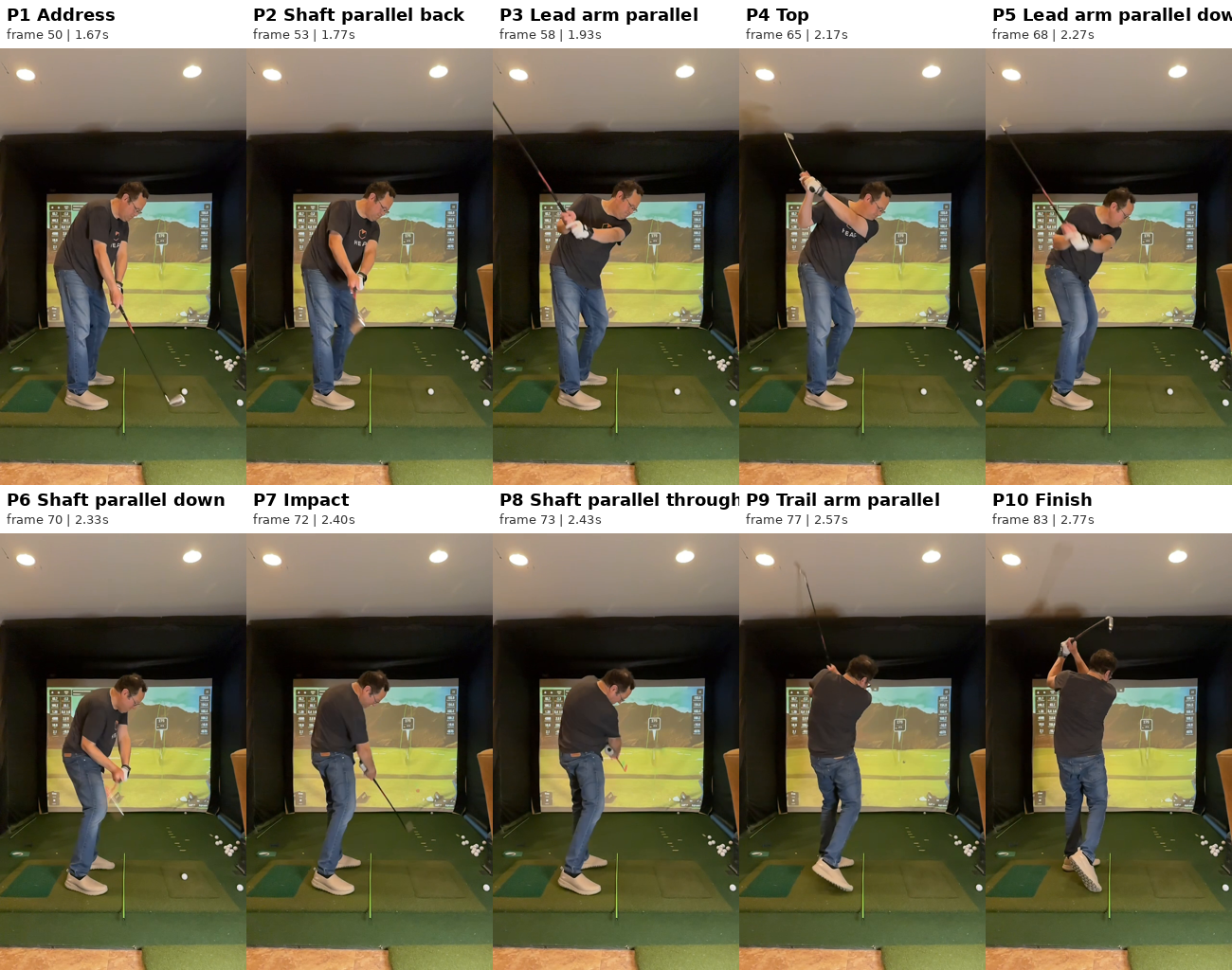
With a swing video, ChatGPT can pull out individual frames and organize them into a contact sheet. For a full swing, that means it can isolate positions like:
- address
- takeaway
- lead arm parallel
- top of backswing
- transition
- shaft parallel on the downswing
- impact
- early follow-through
- finish
That is useful because a golf swing happens too fast to evaluate easily in real time.
A contact sheet lets you slow everything down and compare positions side by side.
That does not mean every frame is perfect. Sometimes the exact P-position is between frames, especially if the video is only 30 frames per second. Sometimes camera angle, wide-angle distortion, or lighting makes things harder to judge.
But even with those limitations, contact sheets are extremely helpful.
They give you a way to look at the swing as a sequence rather than just a blur.
My Starting Point
I’m starting this experiment as roughly a 10-handicap golfer with decent speed, but with some recurring consistency issues that I’d like to clean up.
My good shots are good enough. That is part of what makes this interesting. I’m not trying to find 30 extra yards or completely rebuild my swing. I’m trying to make the swing more predictable, especially when I’m not timing it perfectly.
My common full-swing misses include:
- inconsistent low point
- overdraws or hooks
- occasional heel contact
- shots that start right and turn over too much
- the feeling that my trail arm can get trapped behind me
- contact that can get worse when I try to force the swing instead of staying organized
That makes this a good test case for using ChatGPT as a practice assistant.
The question is not whether ChatGPT can give me a perfect golf lesson. The question is whether it can help me organize the information I already collect – swing video, contact sheets, launch monitor numbers, and practice notes – and turn that into a more focused plan.
For the baseline, I uploaded down-the-line and face-on swing videos. ChatGPT pulled out key frames, created contact sheets, and then looked for patterns that might connect to my normal misses.
That is where the experiment really starts.
The First Swing Pattern ChatGPT Identified
The first full-swing analysis centered around one main pattern:
My swing can get a little crowded coming into impact.
That does not mean the swing is broken. In fact, ChatGPT pointed out several good pieces: I stay balanced, I make an athletic move, I get through the shot, and I can create playable impact alignments.
The issue is more about how much room I have to deliver the club consistently.
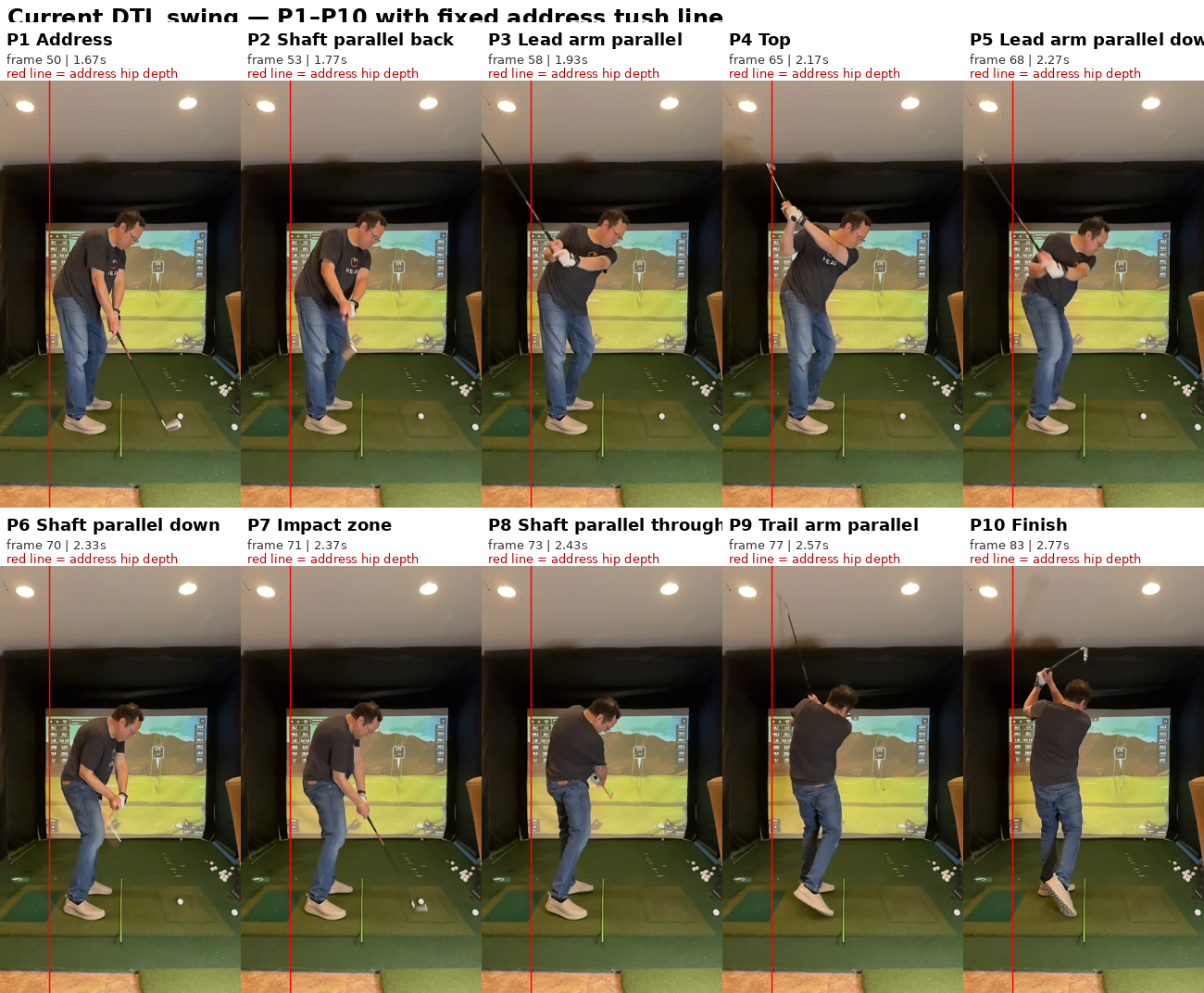
From the down-the-line view, ChatGPT saw that the club and arms can work a little deep going back. In plain English, that means the hands and arms can wrap slightly too far around me instead of staying more organized in front of my torso.
Then, in transition, my pelvis can move slightly toward the ball. That reduces the space available for my hands and arms on the way down.
When those two things happen together, the delivery can get tight. The club can approach from too far inside, the handle can get crowded, and impact becomes more dependent on timing.
That matches a lot of my usual misses.
When I’m timing it well, I can hit solid shots. But when the sequence is a little off, I can see the ball start right and overdraw, or I can get heel contact, low-point problems, or the feeling that my trail arm is stuck behind me.
The most useful part of the analysis was that it did not give me a huge list of random flaws. It connected a few pieces into one main pattern:
A slightly deep backswing plus some loss of space in transition can lead to a stuck, overly in-to-out delivery.
That gives me something specific to test.
The initial practice priorities are:
- keep the club and arms a little more in front of my body going back
- maintain better hip depth in transition
- create more room for my hands through impact
- let the handle exit left with body rotation
- reduce the tendency to get excessively in-to-out
The goal is not to force a perfect-looking position. The goal is to see whether these changes lead to better strike, less curve, and more predictable ball flight.
That is what I’ll be tracking over the next 30 days.
The Launch Monitor Data Matters Too
Video alone can be misleading.
A swing can look better and produce worse shots. A swing can look a little unusual and still work well. A single camera angle can also exaggerate or hide certain movements.
That is why I also uploaded launch monitor data.
This is where the process became more useful.
For my 8-iron swings, ChatGPT looked at carry distance, ball speed, club speed, smash factor, launch angle, spin, peak height, path, angle of attack, spin axis, and offline dispersion.
The biggest takeaway was that my swing speed was fairly consistent. My carry variation was more related to strike quality and ball speed than to effort level.
That matters.
If my club speed were all over the place, I might need to work on tempo or effort control. But if the speed is consistent and the ball speed varies, that points more toward strike and delivery.
The data also supported the video analysis that my path can get too far in-to-out. That fits my tendency to start the ball right and turn it over too much.
So the video and launch monitor data were telling a similar story.
That makes the recommendation more useful.
The practice goal is not just “make a prettier swing.”
The goal is to improve the delivery pattern enough that strike, launch, and curve become more predictable.
Short Game Too: 40-Yard Pitch Shots
I also tested the same process with a 40-yard wedge shot.
That is important because short game analysis is different from full-swing analysis.
With a full swing, I might be looking at speed, path, curve, strike, and overall delivery. With a 40-yard wedge shot, the priorities are different:
- setup
- pressure
- low point
- backswing length
- launch window
- spin
- carry distance
- rollout
- avoiding thin or low-launch runners
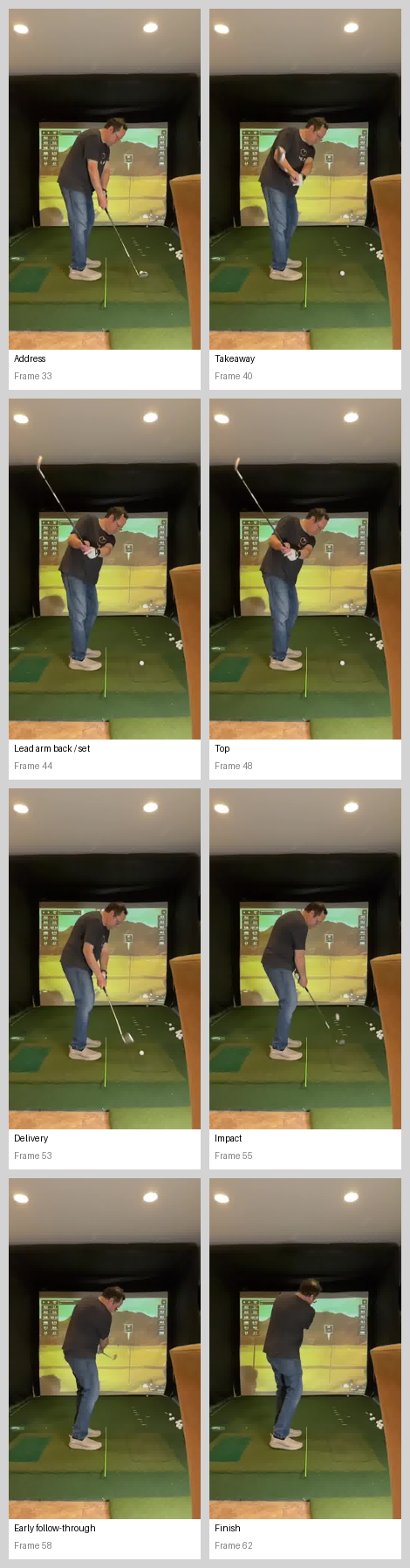
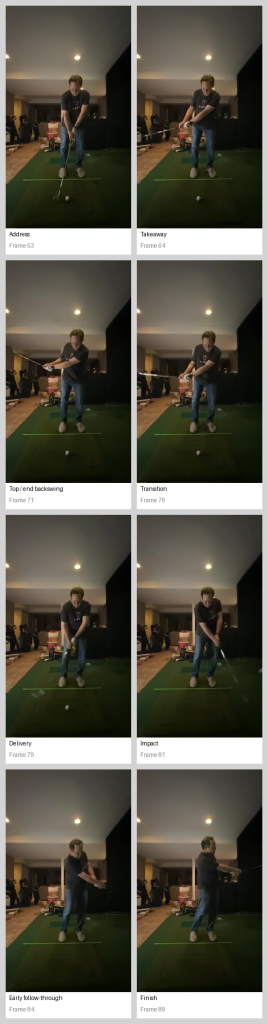
ChatGPT created contact sheets for both down-the-line and face-on views of my 40-yard pitch motion.
The feedback was actually encouraging.
The motion looked functional. Direction control was good. The bigger issue was avoiding the occasional shot that launched too low and ran out too far.
That changed the practice recommendation.
Instead of trying to hit more down on the ball, the better goal was to keep the motion smooth, maintain chest rotation, and avoid a stabby or handle-dragging delivery.
That is a good example of why data matters.
Without the launch monitor data, I might have focused on the wrong fix.
What I Want ChatGPT to Help With
For this 30-day experiment, I want ChatGPT to help with four things.
1. Organizing swing video
I want contact sheets from new swings so I can compare positions over time. This should make it easier to see whether anything is actually changing.
2. Connecting video to ball flight
I do not want to work on a swing position just because it looks bad. I want to connect the video to actual misses and launch monitor numbers.
3. Building practice plans
The real value is not just analysis. The real value is turning the analysis into a useful practice session.
For example, instead of saying “work on hip depth,” I want a specific 30-minute plan that tells me what drills to do, what feels to use, and what numbers to track.
4. Tracking whether the advice works
This is the most important part.
Some advice sounds good but does not help. Some feels work for one session and disappear the next day. Some drills improve contact but do not transfer to normal swings.
I want to track that honestly.
What I’ll Track During the 30 Days
I do not want this to become a purely subjective experiment.
I’ll still use feel and video, but I also want to track a few numbers.
For full-swing sessions, especially with an 8-iron or long iron, I’ll pay attention to:
- carry distance
- carry consistency
- ball speed
- smash factor
- launch angle
- peak height
- club path
- spin axis
- offline dispersion
- number of big left misses
For wedge sessions, I’ll pay attention to:
- carry distance
- total distance
- carry consistency
- launch angle
- spin
- rollout
- number of low-launch runners
I do not expect every number to improve immediately.
Golf does not work that way.
But over 30 days, I want to see whether the overall pattern moves in the right direction.
How Often I’ll Update
My plan is to post an update every 2–3 days.
Each update will probably include:
- a new swing video or contact sheet
- what ChatGPT noticed
- what I practiced since the last update
- what improved
- what did not improve
- whether the launch monitor data changed
- the next practice plan
I do not want to change everything every two days. That would defeat the purpose.
The plan is to keep the main priorities stable, then make small adjustments based on what the video and data show.
If something is working, I’ll keep it.
If something is not helping, I’ll say so.
What I’m Not Claiming
I want to be clear about this.
I am not claiming ChatGPT is a replacement for a good golf instructor.
It is not.
A good coach can see things in person, watch ball flight, understand matchups, and give immediate feedback. ChatGPT cannot fully replace that.
ChatGPT can also be wrong. Camera angles can be misleading. A single swing can be misleading. Even launch monitor data can be misread if you do not understand the context.
So I’m not treating this as a perfect diagnosis machine.
I’m treating it as a practice assistant.
The question is not:
Can ChatGPT give perfect golf instruction?
The better question is:
Can ChatGPT help me practice more intelligently, track progress more clearly, and make better use of the video and data I already collect?
That is what I want to find out.
Upcoming Posts in the Series
Here is the rough plan for the series.
Day 0: The Baseline
This post introduces the experiment, shows the initial contact sheets, explains the first swing analysis, and outlines the plan.
Day 3: First Practice Update
I’ll share the first practice session, what I worked on, and whether the initial feels made any difference.
Day 6: New Swing Video Check-In
I’ll upload a new swing video and compare it to the baseline. The goal will be to see whether the club is less deep, whether I am maintaining more space, and whether the ball flight changes.
Day 9: Launch Monitor Review
This update will focus more on the numbers. I’ll look at whether ball speed, carry consistency, path, spin axis, and dispersion are moving in the right direction.
Day 12: Short Game Check-In
I’ll revisit the 40-yard wedge shot and see whether I can reduce low-launch runners and tighten carry/total distance control.
Day 15: Midpoint Recap
At the halfway point, I’ll summarize what has helped, what has not helped, and whether the experiment seems useful.
Day 18–27: Continued Updates
These posts will continue the same process: new video, new data when available, updated practice plans, and honest notes on what is actually changing.
Day 30: Final Review
At the end, I’ll compare the baseline to the final videos and data.
The final question will be simple:
Did using ChatGPT as a golf practice assistant help?
My Goal for the Next 30 Days
My goal is not to create a perfect swing in 30 days.
That is not realistic.
My goal is to see whether I can make practice more focused and measurable.
If this works, I should have:
- clearer swing priorities
- better contact sheets for comparison
- more useful launch monitor analysis
- better structured practice sessions
- a clearer understanding of what helps and what does not
That alone would be valuable.
Because for most amateur golfers, including me, the problem is not a lack of things to work on.
The problem is figuring out which things actually matter.
That is what I’m hoping ChatGPT can help with.
Let the experiment begin.
Discover more from Ten to Scratch
Subscribe to get the latest posts sent to your email.